Read the treeStructure, condition, lean, and canopy load.
Nanaimo & Mid-Island request lineCall direct · (778) 764-1440 ext. 214
Nanaimo tree service · assessment-led planning
Nanaimo tree servicefor property-aware planning.
Planning information for tree assessment, pruning, storm response, controlled removal, supplemental support, and stump grinding—organized around the tree, the targets below, and current Nanaimo requirements.
- Tree-by-tree questions
- Permit-aware planning
- Property-first scope
Assessment-led tree planning. Share the tree, targets, and access.
Map the targetsRoof, garden, utilities, traffic, and access.
Choose the systemClimb, rig, lower, prune, or remove in sections.
Control the finishDebris, stump, access, and site condition.
The zero-drop-zone plan
Before the first cut, map what cannot be hit.
Select each marker. A precision removal begins with the targets below the canopy, then designs the rope system around them.
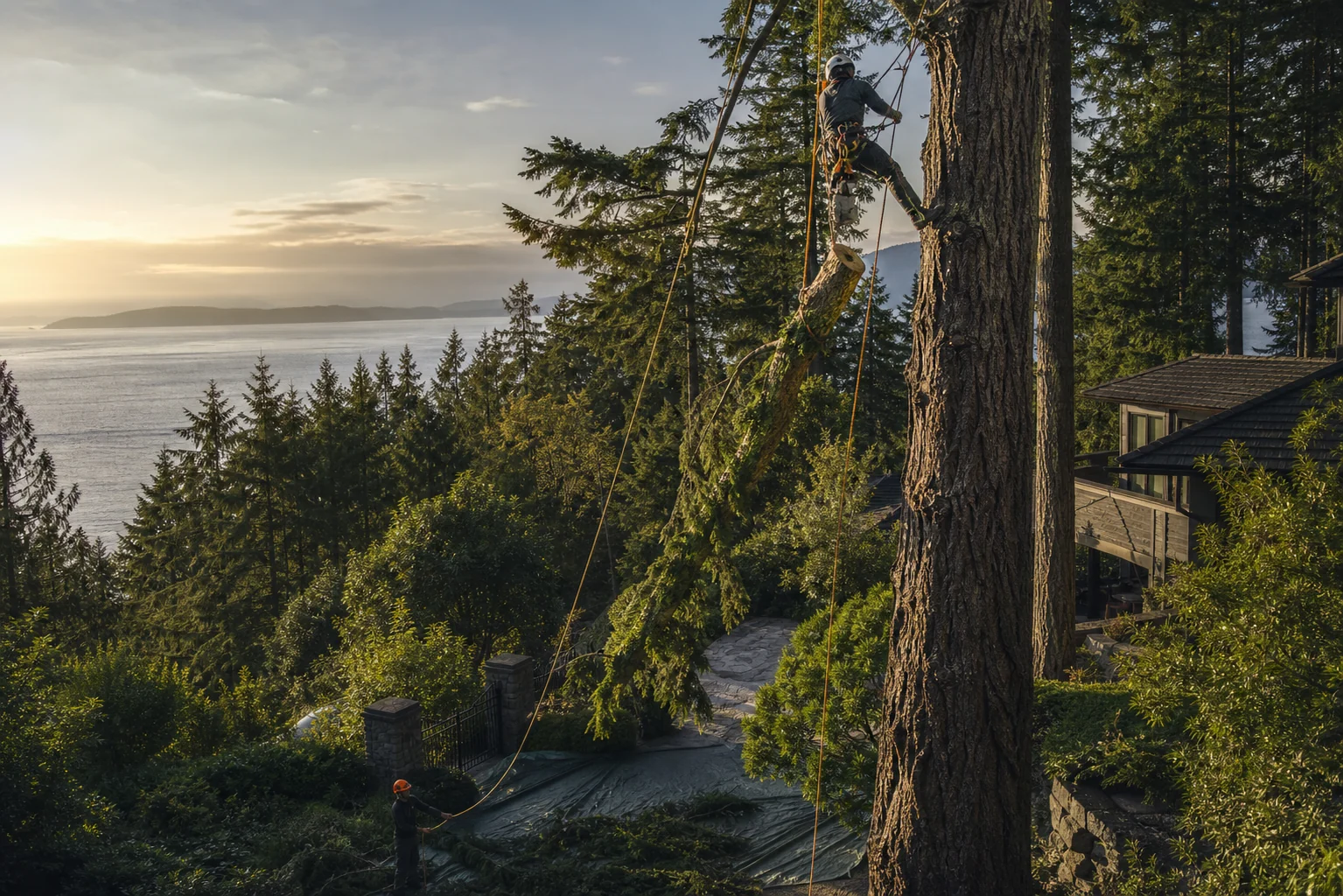
Anchor above the work.
The climber reads unions, weight, defects, and rope angles before selecting a tie-in and rigging point.
Build the removal profile
The property decides the method.
Height matters, but access and nearby targets often change the plan more.
Precision profile · Controlled rigging
Sectional removal with controlled lowering.
When access is limited and targets sit below the canopy, the work is broken into manageable pieces and moved through a planned rope system.
Climber accessRigging pointsProtected drop zoneGround control
Choose the right starting point
The best outcome is not always removal.
Begin with the concern you actually have. Each path explains what should be assessed before scope, price, or equipment is discussed.
01Assess
I do not know what the tree needs.
Start with visible condition, recent changes, the targets below, and whether retain, monitor, prune, support, or remove deserves consideration.
Review tree assessment →02Prune
I want to keep the tree.
Define a pruning objective around structure, deadwood, clearance, or a specific load—without defaulting to topping or unnecessary removal.
Review pruning & crown care →03Support
A union or heavy limb concerns me.
Explore whether pruning, monitoring, or supplemental support may help retain a valued tree and what future inspection would involve.
Review support planning →04Remove
The tree may not be retainable.
Plan permit status, access, rigging, targets, debris, and stump expectations before the first cut or machine arrives.
Review controlled removal →Storm or sudden change
Fresh lean. Split union. Hanging limb.
Keep people clear of the area. If a tree or branch is touching or close to a power line, stay back and contact BC Hydro first. Otherwise, describe what changed, what sits below it, and whether access is blocked.
Direct Nanaimo request line(778) 764-1440 ext. 214Assigned extension is included in the call button.Send property details ↗
Tree-care decisions
Right work. Right tree. Right reason.
A useful recommendation may be pruning, sectional removal, storm response, or a clearer assessment of what you are seeing.
010203040506
Tree Health & Risk Assessment
Planning guidance for visible defects, crown condition, targets, and practical retain, prune, monitor, or remove questions.
Keeps the condition of the tree central instead of assuming removal is the answer. →Storm Damage Tree Response
Safety and scope guidance for hung limbs, split stems, and wind-compromised trees after coastal storms.
Prioritizes site control before the next weather window arrives. →Tree Pruning & Crown Care
Planning information for clearance, deadwood, and structural crown care around Nanaimo homes.
Supports discussion about retaining useful trees and addressing defined clearance concerns. →Tree Removal
Scope guidance for sectional or controlled takedowns when retention is not a reasonable option.
Keeps structures, neighbouring space, utilities, and access central to the work plan. →Stump Grinding
Planning information for stump grinding when a yard, fence line, or planting area needs a defined finish.
Clarifies the depth, access, utility, chip, and restoration questions that affect the ground afterward. →Tree Cabling & Support Planning
Planning guidance for weak unions or heavy limbs where supplemental support and monitoring may be considered.
Explains a retention question when removal may not be the only reasonable path. →How it works
A controlled finish starts on the ground.
Climber, rope system, ground crew, landing zone, and cleanup all work as one sequence.
- 01Assess
Read the full property.
Discuss the objective, examine the tree from multiple angles, and identify the things the work must protect.
- 02Design
Choose access, anchors, and sequence.
Plan the route into the canopy, the order of cuts, and how material will move to the ground.
- 03Control
Keep the ground crew in the system.
Clear communication and managed rope tension turn canopy decisions into predictable movement below.
- 04Finish
Leave the site with intention.
Confirm debris handling, stump scope, access restoration, and the agreed condition of the work area.
Why this assessment approach matters
The property is part of the tree plan.
A useful scope accounts for what must remain protected: the home, landscape, access, neighbouring space, and trees meant to stay.
Targets mapped before cutting.
Roof lines, gardens, utilities, traffic, and access inform the climb and rigging strategy from the start.
Removal is not the default.
The recommendation can include pruning or crown care when that better matches the tree and the homeowner’s objective.
The finish is scoped early.
Debris handling, stump work, access needs, and site condition belong in the conversation before work begins.
Three questions before you call
What changed?
You do not need to diagnose the tree. These observations make the first conversation more useful.
- 01Did the lean, crack, or hanging limb appear recently?A recent change can matter more than size alone.
- 02What is directly below or beside it?Home, road, service line, neighbour, garden, or open lawn.
- 03Can equipment reach the work area?Gate width, slope, soft ground, steps, and overhead clearance define access.
- Nanaimo
- Lantzville
- Parksville
- Qualicum Beach
- Cedar
- Departure Bay
Tree-work questions for the coast.
Start with your address, the tree, and what concerns you.
Tree service questions
Know what shapes the plan.
Clear answers make it easier to understand the recommendation and compare the scope.
Does a leaning tree always need to be removed?
No. Some trees naturally lean. The more useful questions are whether the lean changed, what the root plate and trunk show, how the canopy is loaded, and what targets are nearby. A site assessment is the right starting point.
Can the tree be pruned instead of removed?
Sometimes. Clearance, deadwood, crown weight, structure, condition, and the homeowner’s objective all matter. A good assessment should explain when pruning is appropriate and when it would not resolve the concern.
Will the job require a crane?
Not automatically. Tree size, access, surrounding targets, rigging options, ground conditions, and the available work zone determine whether climbing and rope systems are suitable or another access method should be considered.
What affects the tree-service quote?
Tree height is only one factor. Species, condition, canopy spread, targets below, access, slope, rigging complexity, debris handling, stump scope, and the requested finish can all change the work.
Is stump grinding included with removal?
It should be discussed as a separate scope item unless the proposal clearly includes it. Stump diameter, location, surface roots, access, utilities, and the desired depth or finish all matter.
What should I do with a storm-damaged tree?
Keep people away from hanging limbs, split trunks, and compromised areas. Avoid cutting tensioned or suspended material yourself. Call and describe what changed, what is below it, and whether access is blocked.
Do I need a City of Nanaimo permit to remove or extensively prune a tree?
You may. The City of Nanaimo directs owners to review its Tree Management and Protection Bylaw and permit information before removing, extensively pruning, or topping a tree. Requirements depend on the tree and property, so confirm the current rule with the City before work starts.
Can a hazardous-looking tree be retained?
Sometimes. Pruning, target management, monitoring, or supplemental support may reduce a specific concern. Other defects or site conditions may make removal the reasonable option. A tree-by-tree assessment should explain the trade-off instead of assuming every concern needs the same treatment.
Plan the work before the first cut
Protect the property. Control the finish.
Start with tree-by-tree questions and a scope built around the home, access, permit question, and the outcome you actually want.